Journalism
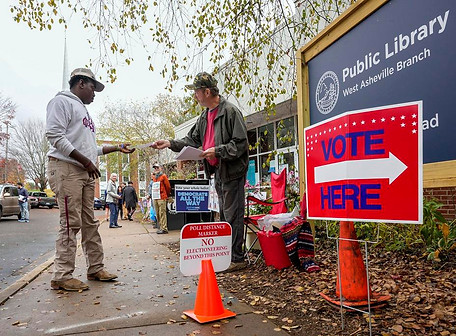
The successful ballot measure hasn’t gotten much notice in the wake of Trump’s victory, but it has dangerous implications.

Harris’s failure is a direct result of a weak Democratic brand that once again abandoned Generation Z and undermined young voters’ trust in government institutions. Young people see a failed two-party system that ignores their concerns—and progressive youth see Democratic politicians who promised to create a more equitable America and yet are no longer acting in their best interests.

Western North Carolinian communities are forced to reckon with decades of political and economic neglect and now the Helene recovery. They also fear that America will once again forget all about Appalachia now that Helene has literally stripped away its appeal as a climate sanctuary.

The rural vote is the difference between another Trump administration or maintaining a blue executive office. Declining news organizations in rural America led to an absence of voter participation. Since rural Ohio, among other states, is without reliable, high-speed internet, face time between candidates is crucial. If Sherrod Brown fails to secure another term, it's indicative of a weak Democratic brand in rural Ohio.

In June 2024, North Carolina state lawmakers repealed RTA reforms like the transfer provision. The supporters of the repeal claimed that the move would help reduce juvenile case backlogs. Gov. Roy Cooper (D) vetoed the bill later that month, but the Republican-controlled General Assembly overrode his decision.
With the legislature committed to penalizing young people, Winston-Salem social services organizations have been moving in a different direction to devise much-needed strategies to guide and support young people, especially troubled adolescents, growing up in neighborhoods like East Winston.

As The Appalachian's first Black Visual Managing Editor, I had the pleasure of introducing our third Black History Month Edition with a Letter From the Editor about understanding and acknowledging identity.
"I have always said the place to be understood is within journalism. Word possesses truth, either personal or objective. Words have power. We have power. It is about how we use it for ourselves and others."

When outreach coordinator Hannah Woodburn first entered the position at MountainTrue, she assumed her primary concern was to eliminate the physical pollutants of Boone’s waterways. Then, a colleague’s seven-year-old died after contracting E.coli from the Eno River.

On the McDowell Plantation in Morganton sat a brick marred with fingerprints. It was unearthed during a restoration. The prints were so distinct, one could fit their fingers in the grooves left behind. This brick immortalizes the presence of enslaved people in Appalachia.
Last spring, Interdisciplinary Studies adjunct instructor Leslie McKesson and her honors IDS 3540 Antebellum Slavery in Appalachia class visited the McDowell Plantation as part of their semester-long project uncovering the experiences of enslaved people in Appalachian communities.

"Don’t survive; let’s thrive,” Dr. Will Sheppard tells his cohort of young Black men, a group of university freshmen and sophomores. He urges them to share their trouble in detail instead of suppressing their emotions with a “No, I’m good,” or “I can handle it.”
Dr. Sheppard and Dr. Brandy Bryson set out to create a dynamic academic and social space for Black males at Appalachian State, the first cohort in its history dedicated to Black Male excellence.

Huddled between the front door and a TV, Luska makes their debut performance in their lead singer’s house. String lights draped from high ceilings, lamps illuminate their makeshift stage as Barrett Conner belts out his original song “Solid Ground.”
He looks beyond the wall-to-wall crowd. One hundred and fifty people filled his cramped home, gathering in the living room, kitchen, and extending back into his bedroom.
The members of LUSKA didn’t anticipate such a turnout, only expecting around 30 people. Despite officially forming in January, the community voted LUSKA for this year’s Best Local Band.

A silicone hairless cat greets visitors of Noble Tattoos & Piercings. From the tip of its ears to the rubbery skin of the chin, its face and head are adorned with metal jewelry. Sandwiched between original artwork and tattoo mockups, the cat lounges from a high ledge, overseeing the piercing process from start to finish.
Purple tongue rings, curved blue barbells and long industrial bars made of titanium are displayed in a protective glass case. Noble cautions for foul language and “mild nudity.” Only those 18 years and older are allowed upstairs.

A jailhouse marred with tally marks, a fraternity house to college students and Proper, a Southern bistro with an “Eat More Collards” slogan.
These facilities occupied 142 Water St., a property Boone’s Town Historic Preservation Commission is considering for Historical Landmark Status.